
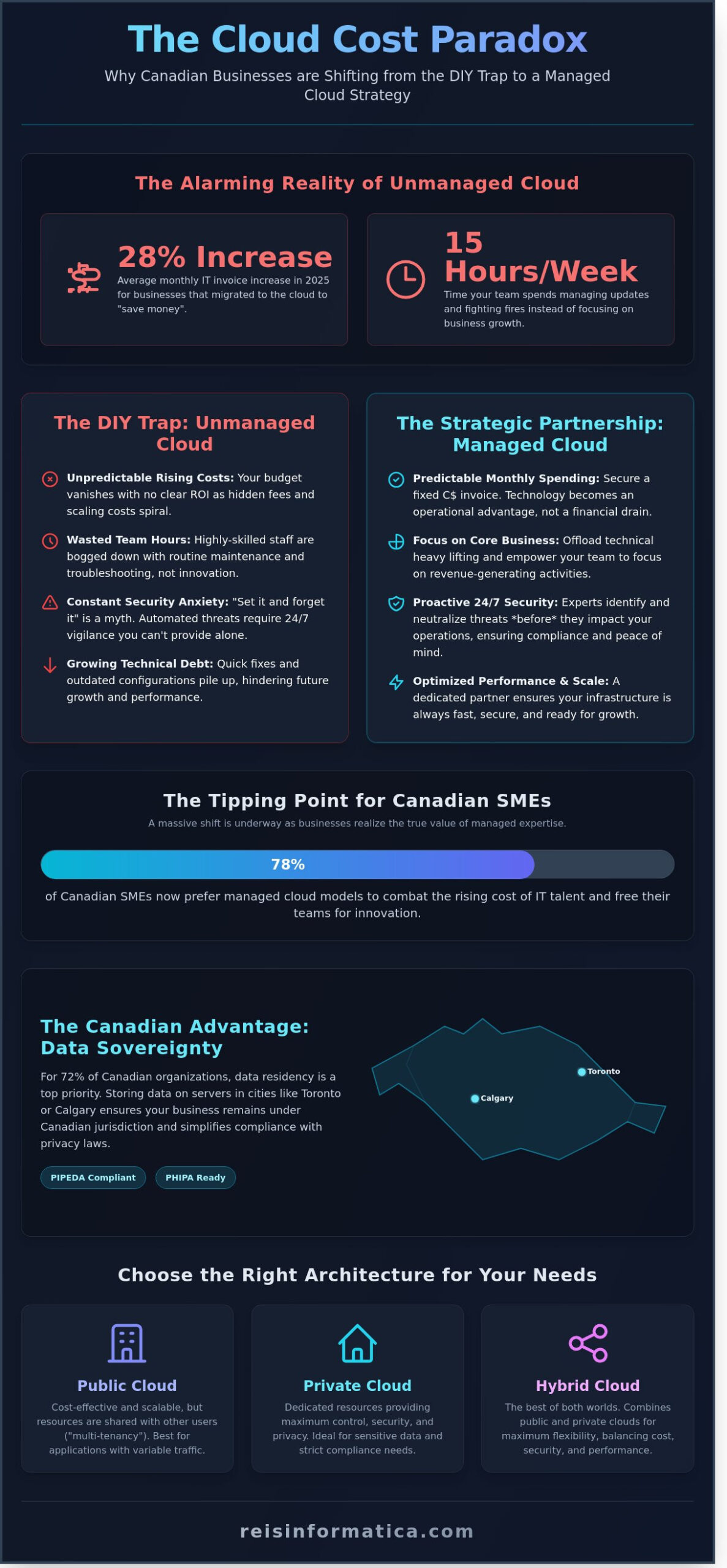
If your business migrated to the cloud to save money, why did your average monthly IT invoice increase by 28% throughout 2025? For many Canadian executives, the dream of digital efficiency has turned into a cycle of rising costs and constant security anxiety. You’ve likely noticed that simply having a server isn’t enough when your team is spending 15 hours a week just managing updates. Transitioning to a managed cloud infrastructure allows you to stop fighting fires and start focusing on your actual business goals. It’s about moving away from technical debt and toward a predictable, secure environment that respects Canadian privacy laws like PIPEDA.
We understand the frustration of seeing your IT budget vanish without a clear return on investment. You want technology to be invisible and efficient, not a source of stress. This guide provides a clear roadmap to help you secure predictable monthly spending in C$ and build a foundation that scales without requiring a massive hiring spree. We’ll explore the critical components of a 2026 cloud strategy, from proactive monitoring to specialized support that acts as your vigilant partner. By the end of this article, you’ll know exactly how to choose a provider that protects your data and your bottom line.
Key Takeaways
- Shift your focus from managing hardware to subscribing to outcomes, allowing you to eliminate technical debt and focus on your core business growth.
- Navigate the complexities of public, private, and hybrid models to find the right managed cloud infrastructure for your specific operational needs.
- Protect your data and maintain compliance by understanding why server locations in cities like Toronto or Calgary are vital for Canadian businesses.
- Uncover the “hidden” costs of DIY cloud management and learn how to calculate the real impact of downtime on your bottom line.
- Use our expert checklist to evaluate service providers based on their local presence and ability to provide proactive, 24/7 infrastructure monitoring.
What is Managed Cloud Infrastructure and Why Does It Matter in 2026?
For business owners in Mississauga and Milton, the days of buying a physical server and tucking it into a ventilated closet are officially over. By 2026, the conversation has shifted from what hardware you need to buy to what business outcomes you want to achieve. Managed cloud infrastructure is the backbone of this transition. It replaces the old model of ownership with a model of performance; instead of managing a stack of digital tools yourself, you partner with experts who ensure those tools are always fast, secure, and ready to scale.
Think of it as the difference between owning a car and having a private driver and a dedicated mechanic on call. You still get to your destination, but you no longer worry about the oil changes, the tires, or the traffic patterns. A Managed Cloud Service Provider (MCSP) acts as your strategic partner, aligning your digital resources with your executive goals. Managed cloud is a service that handles architecture, security, and maintenance so you don’t have to.
The End of the “Set It and Forget It” Era
The myth that the cloud is inherently safe just because it’s off-site has been debunked by the reality of 2026. Data from the Canadian Centre for Cyber Security indicates that automated threats now target local businesses regardless of their size. This makes 24/7 vigilance a requirement rather than a luxury. You can’t just set up a cloud environment and walk away; it requires constant monitoring to stay ahead of sophisticated ransomware. Managed cloud infrastructure provides this proactive optimization, identifying potential security gaps or performance dips before they impact your bottom line. It’s about staying ahead of the curve, not just reacting when something breaks.
Beyond Storage: The Business Value of Managed Services
Many local firms in the GTA are moving away from DIY cloud setups because they’ve realized the hidden costs of downtime. Recent industry reports show that 78% of Canadian SMEs now prefer managed models over in-house maintenance to combat the rising cost of IT talent. When your internal staff spends hours troubleshooting server lag, they aren’t working on your next big product launch. By offloading the technical heavy lifting, you free your team to focus on innovation. This is particularly crucial for companies adopting AI business solutions, which demand high-performance computing power that is difficult to manage without specialized expertise. In 2026, having a managed partner means you’re not just storing data; you’re leveraging an engine that drives efficiency across your entire organization.
Public, Private, or Hybrid? Choosing the Right Architecture in Canada
Selecting the right foundation for your digital operations isn’t just a technical choice; it’s a strategic business decision. For Canadian SMEs, the architecture you choose dictates how you handle growth, security, and legal obligations. A robust managed cloud infrastructure ensures these technical layers work together without needing your constant attention.
Data residency remains a top priority for 72% of Canadian organizations. Knowing exactly where your servers live matters for more than just speed. When your data stays in Toronto or Calgary data centers, it remains under Canadian jurisdiction. This simplifies your legal landscape and prevents your sensitive information from being subject to foreign laws that might conflict with your business interests.
Compliance isn’t optional for modern firms. The Personal Information Protection and Electronic Documents Act (PIPEDA) requires strict controls over how you store and access personal data. If you operate in the healthcare sector, you might also need to align with provincial acts like Ontario’s PHIPA. Local servers provide the physical peace of mind that your data never leaves the country, keeping your compliance audits clean and straightforward.
Public Cloud vs. Private Cloud: The Security Trade-off
Public cloud providers offer massive scale through multi-tenancy, which means you share physical hardware with other users. While cost-effective, this “apartment building” style of hosting can be a risk for firms with extreme privacy needs. Integrating professional cybersecurity services adds a vital protective layer, ensuring your “neighbors” in the cloud don’t compromise your data integrity. Private cloud options are the standard for highly regulated industries in Ottawa and Kingston. You get dedicated hardware and total control, eliminating the noise and potential vulnerabilities of shared environments.
Hybrid Cloud: The Best of Both Worlds for Growing Firms
Hybrid models offer a bridge for firms in Kitchener and Waterloo that aren’t ready to abandon their on-premise hardware entirely. You can keep sensitive legacy databases on a local server while using the cloud for your customer-facing apps. This approach allows for gradual scaling without a massive upfront bill. Managing the transition between physical hardware and a managed cloud infrastructure requires a clear roadmap to avoid downtime. Latency drops significantly when you use local hubs, often reaching speeds under 15ms, which is critical for real-time applications. If you’re unsure which path fits your current growth stage, exploring tailored cloud solutions can help clarify your roadmap.
Managed vs. Unmanaged Cloud: Analyzing the Real ROI
The most common misconception we hear from business owners in Southern Ontario is that DIY cloud is cheaper because there’s no management fee. On paper, it looks like you’re saving money. In reality, you’re often just trading a predictable monthly invoice for a mountain of hidden costs and technical debt. It’s a financial trap. Choosing managed cloud infrastructure isn’t an extra expense; it’s a strategic move that shifts your budget from unpredictable Capital Expenditure (CapEx) to a stable, monthly Operating Expenditure (OpEx) model.
Managing your own cloud environment means your team is responsible for every update, security patch, and configuration tweak. If a server goes down in the middle of a Tuesday afternoon, the cost of downtime for a business in London or Mississauga can easily exceed C$10,000 per hour. When you factor in lost employee productivity and missed sales, the “free” management of a DIY setup starts to look incredibly expensive. Managed providers eliminate this volatility by guaranteeing uptime and providing instant support when things go wrong.
The True Cost of Technical Debt
Unoptimized cloud environments leak money every single minute. Without expert oversight, many businesses pay for server resources they never use or get hit with massive egress fees for moving data inefficiently. Recent industry data shows that organizations waste roughly 32% of their cloud budget on unnecessary resources. Our experts identify these inefficiencies by right-sizing your instances and automating scaling. It’s a simple truth that managed cloud often pays for itself through resource optimization alone.
Risk Mitigation and Business Continuity
A data breach is the ultimate ROI killer. In 2023, the average cost of a data breach for Canadian companies reached a staggering C$6.94 million according to IBM’s annual report. Proactive management identifies vulnerabilities before they become disasters. Beyond security, a managed approach ensures your business stays online even during local infrastructure outages or hardware failures. You gain the peace of mind that comes from managed IT services, knowing that a team of specialists is monitoring your environment 24/7. This level of vigilance allows your internal team to stop worrying about servers and start focusing on growth.
Choosing Your Partner: A Checklist for Canadian Business Leaders
Selecting a partner for your managed cloud infrastructure is a high-stakes decision that dictates your company’s agility for years. In 2026, the technical baseline has shifted; simply “being in the cloud” isn’t enough. You need a partner who acts as a vigilant guardian of your uptime. Start by scrutinizing the Service Level Agreement (SLA). A professional provider should offer a 99.99% uptime guarantee, backed by clear financial credits if they miss the mark. Don’t settle for vague promises; look for specific response times for critical incidents, often measured in minutes, not hours.
Geography remains a vital factor for performance and compliance. A provider with a physical presence in cities like Halifax or Calgary offers more than just lower latency. They understand the Canadian regulatory environment, including PIPEDA and provincial privacy laws. This local expertise ensures your data residency requirements are met without compromise. When you evaluate technical expertise, look for gold-tier certifications from major vendors. These credentials prove the team has undergone rigorous training and possesses the specialized knowledge to manage complex environments securely.
Culture fit is the final, often overlooked, piece of the puzzle. Your provider must understand the Canadian market’s unique pace and values. They should function as an extension of your team, speaking the language of business results rather than hiding behind technical jargon. This alignment ensures that when your business scales, your infrastructure scales with it, keeping your operations seamless and your mind at ease.
Essential Questions to Ask Potential Providers
Before signing any agreement, ask if the provider offers true 24/7/365 local support. You don’t want your urgent requests routed to a call center in a different time zone where the staff isn’t familiar with your specific setup. Inquire about their data migration methodology. A reliable partner will have a documented process to move your workloads without interrupting your daily operations. Finally, ask about their specific experience with cloud services for your specific industry. A law firm in Toronto has vastly different security needs than a manufacturing plant in Windsor.
Red Flags in Managed Cloud Contracts
Be wary of “vendor lock-in.” If a contract includes proprietary tools that make it nearly impossible to migrate your data later, it’s a significant risk. Transparency in pricing is equally critical. In 2026, some providers still hide fees for data egress or “premium” support tiers. A C$3,000 monthly quote can quickly balloon by 25% if you aren’t careful about these hidden costs. Ensure the contract includes a clear exit strategy that defines how your data will be returned if the partnership ends. A professional partner isn’t afraid to define the end of a relationship because they’re confident in the value they provide.
Ready to build a resilient foundation for your business? Secure your managed cloud infrastructure with our expert team today.
How Reis Informática Secures and Scales Your Infrastructure
Choosing a partner for your managed cloud infrastructure isn’t just about renting server space; it’s about securing a strategic advantage. We don’t just sell cloud capacity. We build a comprehensive roadmap that aligns your technology with your 2026 business goals. Our consultative approach ensures that every C$1 you spend on your infrastructure contributes directly to your operational efficiency and long-term scalability.
Our proactive monitoring systems act as a 24/7 digital sentry for your Toronto or Ottawa office. We use predictive analytics to identify and resolve 98% of potential system bottlenecks before they ever impact your team’s productivity. This shift from a reactive “break-fix” model to a proactive stance means your employees can focus on their work without the frustration of unexpected downtime. By February 2025, our internal data showed that clients switching to our managed model saw a 40% reduction in IT-related work interruptions.
The Reis Informática difference lies in the combination of local Canadian expertise and enterprise-grade technology. We understand the specific regulatory requirements of the Canadian market, ensuring your data residency and compliance needs are met with precision. You get the power of global infrastructure with the personal touch of a local partner who understands the unique challenges of the GTA and Eastern Ontario business corridors.
A Partnership Built on Trust and Transparency
We’re committed to keeping your business focused on growth rather than troubleshooting. Our team conducts regular infrastructure audits every 90 days to ensure your systems remain optimized and secure against evolving threats. These sessions aren’t just technical reviews; they’re strategic meetings where we discuss how to adapt your tech stack to your changing needs. Whether you’re expanding your team in Mississauga or opening a new branch in Nepean, we provide the clarity you need to scale confidently. You’re invited to book a consultation today to see how we can tailor a strategy for your specific region.
Ready to Modernize Your Infrastructure?
Moving to a managed model today offers immediate benefits, including predictable monthly costs and access to a specialized team that would be too expensive to hire in-house. It’s about more than just technology; it’s about gaining the peace of mind that comes with knowing your business is resilient and ready for whatever the future holds. Our experts handle the complexity so you can lead your company with total confidence. For a deeper look at how this fits into your overall strategy, read our Managed IT Guide. Let’s start your modernization journey and build a foundation that scales with your ambition.
Secure Your Competitive Edge for 2026 and Beyond
As 2026 approaches, the complexity of IT shouldn’t hold your Canadian business back. Choosing the right architecture determines your operational speed and long-term costs. Recent industry data indicates that companies switching to a managed cloud infrastructure see a 25% increase in operational efficiency compared to unmanaged environments. You don’t need to be a technical expert to realize that consistent uptime directly impacts your bottom line. By offloading technical heavy lifting, you gain the freedom to focus on growth while professionals handle 24/7 proactive security monitoring.
Reis Informática provides local support teams across Canada, ensuring your data remains 100% PIPEDA compliant. This localized expertise eliminates the stress of navigating complex data residency regulations. It’s time to stop worrying about server maintenance and start focusing on your next big milestone. Our team is ready to build a scalable foundation that grows with your ambitions.
Contact Reis Informática today for a custom managed cloud infrastructure quote
Frequently Asked Questions
What is the difference between cloud hosting and managed cloud infrastructure?
Cloud hosting provides you with the raw virtual space to store data, but you’re responsible for setting up and maintaining the system. Managed cloud infrastructure includes a dedicated team of experts who handle the monitoring, security, and updates for you. It’s the difference between renting an empty warehouse and hiring a logistics team to manage your entire inventory and security 24/7.
How much does managed cloud infrastructure cost for a medium-sized business in Canada?
A medium-sized Canadian business with 50 to 100 employees typically invests between C$2,200 and C$6,500 per month for managed cloud infrastructure in 2026. These costs cover your server resources, proactive 24/7 monitoring, and enterprise-grade security protocols. Your final price depends on your specific storage needs and the complexity of the applications your team uses daily.
Does my data stay in Canada if I use a managed cloud provider?
Your data stays in Canada if you choose a provider that utilizes local data centers in regions like Toronto, Montreal, or Vancouver. We ensure your information resides within Canadian borders to meet strict data sovereignty requirements. This is a standard priority for 85% of our domestic clients who need to keep sensitive information away from foreign jurisdictions.
Can managed cloud help my business comply with PIPEDA regulations?
Managed cloud helps you meet PIPEDA requirements by implementing the digital and physical safeguards that Canadian law demands. Since the updated privacy guidelines in early 2024, audits have become more rigorous, making features like end-to-end encryption and strict access controls essential. We handle these technical layers so your business stays compliant without you needing to master complex privacy legislation.
How long does it take to migrate to a managed cloud environment?
Most migrations take between 4 and 12 weeks from the initial planning phase to the final go-live date. A small office with two or three servers might finish the move in 30 days, while a larger firm with legacy software could take 90 days. We follow a phased approach to ensure your team experiences zero downtime and maintains full productivity during the transition.
Is managed cloud infrastructure more secure than on-premise servers?
Managed cloud infrastructure is generally more secure than on-premise servers because providers invest millions in security technology that most small businesses can’t afford. A 2025 industry report showed that 94% of businesses experienced a significant security improvement after moving to a managed environment. You benefit from 24/7 threat monitoring and automatic patching that protects your business from the latest cyber threats.
What happens if my business needs to scale up quickly?
You can scale your resources up in minutes rather than waiting weeks for new physical hardware to arrive and be installed. If your business experiences a 300% spike in traffic or data needs, the system adjusts instantly to handle the increased load. This flexibility ensures your operations stay smooth and responsive without requiring a large upfront investment in equipment you might not always need.
Do I still need an internal IT person if I have managed cloud?
You don’t need a dedicated internal IT person to manage the technology, but if you have one, they can focus on business strategy instead of fixing servers. Many of our clients save C$75,000 or more annually by using our expert team as their primary technical department. We act as your proactive partner, handling the day-to-day maintenance so your staff can focus entirely on your core business goals.